Cleaning a 12,000 m² Airport Concourse in a 4-Hour Overnight Window
A composite case study: sizing a PUDU MT1 Max fleet to clear a regional terminal concourse between the last arrival and the first departure — and a 10-month payback.
By WhichBot Team
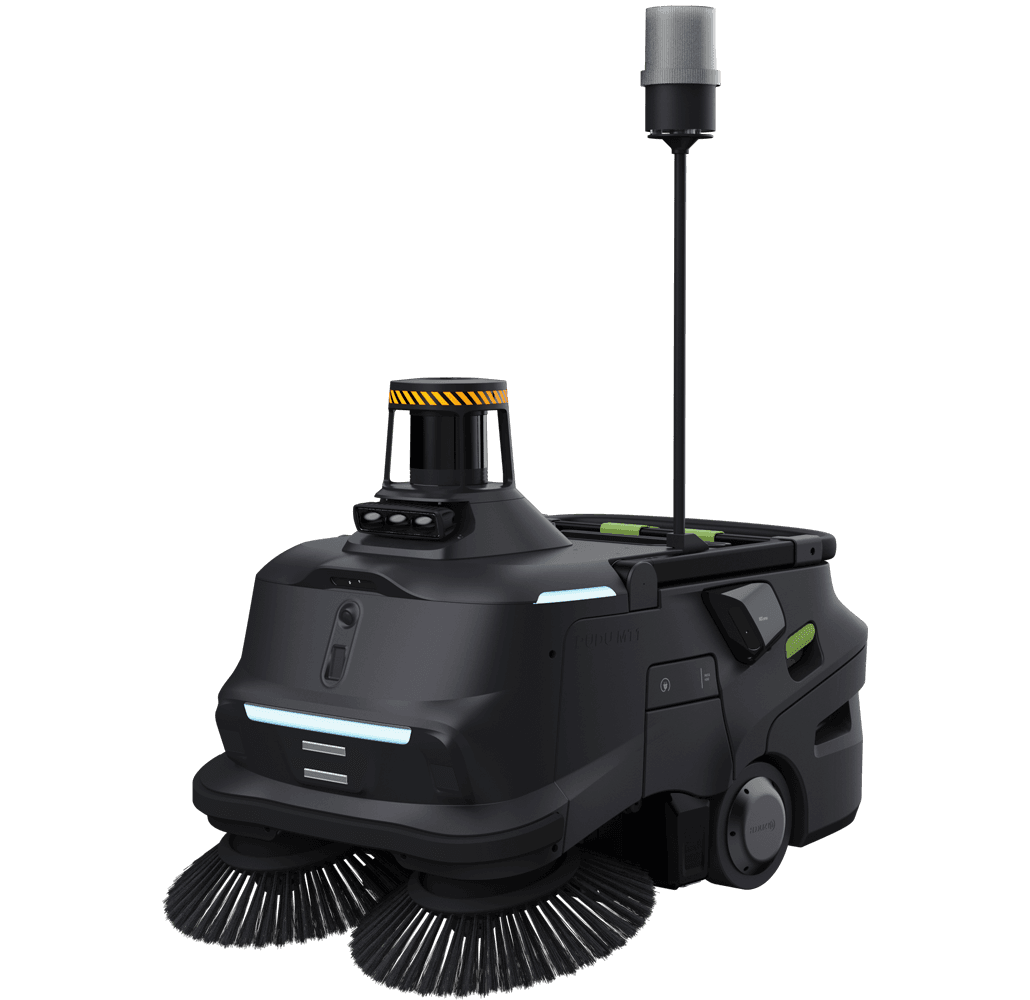
An airport terminal has the hardest cleaning constraint in the business: a large open floor and almost no time. Between the last arrival and the first departure sits a ~4-hour window, and a 12,000 m² regional concourse has to be clear of dust and debris by the time the first passengers walk in. We sized the fleet through the Fleet & ROI Planner — and the answer was about throughput, not floor area.
The brief
The concourse never really closes — it just goes quiet. Cleaning had to finish before the first check-in staff arrived, cover a floor that mixes polished stone and vinyl, and stay reliably clear of overnight retail restock and maintenance crews.
- ~12,000 m² of robot-reachable hard floor across check-in, gates and transit corridors
- A hard 4-hour window, non-negotiable — a delayed finish is a delayed opening
- Long sight-lines (great for autonomy) but constant furniture and stanchion changes
- Must dock and empty the debris hopper without eating the window
The deciding number: throughput vs. window
We size every machine the same way: manufacturer spec figure (midpoint where a range is published) × a derate × an 85% in-window duty allowance that covers docking and zone transitions (hopper emptying on a litter-heavy night is not separately modelled). No brand gets a friendlier basis than its own spec sheet earns — where a vendor publishes a bold theoretical maximum rather than a practical rate we derate it harder (see the footnotes below the table) — and no brand's fleet telemetry is used on its own row. One disclosure, because it is our number and it matters: the 0.6 derate itself is calibrated from measured PUDU fleet data (output ÷ spec averages 0.59 across five PUDU models with confirmed specs, rounded to 0.6 — a sixth PUDU model, the BG1, sits at 0.20 on a thin sample and an unconfirmed sheet and is excluded, which moves the derate in our recommendation's favour) and then applied to every brand identically; the tighter 0.45 has no equivalent calibration — it is a judgement. Both are ours, and PUDU is the only brand whose measured data we hold.
For the MT1 Max that is PUDU's 2,200 m²/h cover-mode figure × 0.6 × 0.85 = ~1,122 m²/h planned. Three units deliver ~3,366 m²/h and clear the concourse in about 3.6 hours:
The overnight window is 4 hours. Docking and zone transitions are already priced into these figures by the 85% duty allowance — two units still need about 5.3 hours, longer than the window exists for. Three clear it with roughly 26 minutes spare.
Where the fleet cleaned mattered as much as how fast. Mapping the concourse by zone showed the transit corridors — always the last to get a manual pass — were where audits slipped:
Zone-by-zone coverage once the fleet went in; the transit corridors are the thinnest. Zone percentages are representative, not audit data. The dock marker is schematic — one is drawn, the fleet needs three. Dock siting is discussed below.
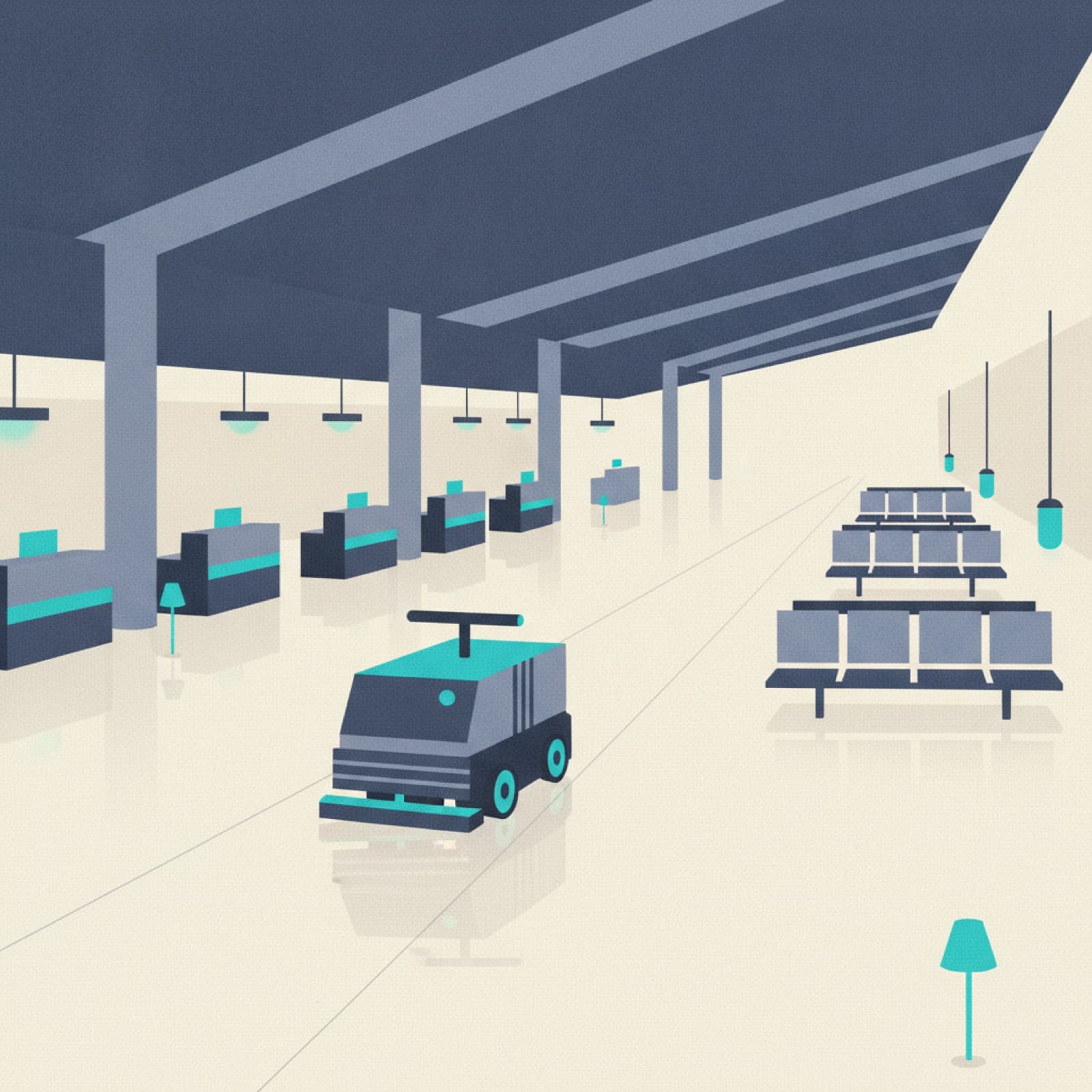
The concourse the fleet works: check-in, atrium, gate lounges and the retail spine, with the machine running the circulation routes between them. Escalators and stairs are not robot-reachable and stay on the manual round — as does the strip under fixed seating.
The shortlist
This is a dry sweep job — dust, grit and passenger litter on hard floor — so the shortlist is the catalogue's dry sweepers. Prices are indicative Australian retail, ex-GST.
| Model | Effective coverage | Units for the window | Clears in | Indicative price | Fleet cost / year*** |
|---|---|---|---|---|---|
| PUDU MT1 Max | ~1,122 m²/h | 3 | ~3.6 h | ~A$39,200 | ~A$23,500 |
| PUDU MT1 | ~918 m²/h | 4 | ~3.3 h | ~A$26,000 | ~A$20,800 |
| Gausium Beetle Pro | ~1,239 m²/h* | 3 | ~3.2 h | ~A$42,700 | ~A$42,700 |
| CenoBots SP50 | ~1,013 m²/h** | 3 | ~3.9 h | ~A$44,700 | ~A$67,000 |
Two other dry sweepers in the catalogue, the PUDU MT1 Vac and the Gausium Vacuum 40, size to five and twelve units on this floor. They're off the shortlist on the same arithmetic, not by selection.
* The Beetle Pro's 3,240 m²/h is flagged in our catalogue as a theoretical maximum rather than a practical rate, so it takes the tighter 0.45 derate; the other three take 0.6. That flag is our judgement about how each vendor writes its numbers, not the vendor's own label — and the counterfactual cuts the other way too: on the 0.6 the other rows get, the Beetle Pro sizes to two units, ~A$28,500 a year on its own term, and pays back in roughly 7.4 months — the best payback in the piece. Whether that flag is right is the single biggest determinant of this table's ranking, and it is our call, not Gausium's.
** The SP50's specs are flagged unconfirmed in our catalogue and it is currently limited availability — treat that row as indicative. Its coverage figure is also the only CenoBots one we treat as a practical rate rather than a theoretical max; on the tighter 0.45 derate it would need four units at ~A$89,400 a year.
*** Hardware capital spread over the service life our planner assumes for that brand — five years for PUDU, three for Gausium, two for CenoBots. That is our planning assumption, not a published vendor warranty, and it is the biggest lever in the column: it is what makes the Beetle Pro read A$42,700 rather than A$25,600. Levelled at a common five years the whole table is MT1 ~A$20,800, MT1 Max ~A$23,500, Beetle Pro ~A$25,600, SP50 ~A$26,800 — the plain MT1 stays cheapest, and the MT1 Max's gap to Gausium is about a tenth of what the column suggests (from the plain MT1 it is about a fifth).
The prices themselves are estimates, not quotes, and they aren't built the same way. The MT1 Max figure is an Australian distributor card price +5%; the MT1 and Gausium figures are US retail listings converted at an indicative FX rate and cut 10%; the CenoBots figure is a US-dollar number quoted in third-party coverage, converted the same way — the thinnest provenance in the table. The Gausium figure also carries a +20% uplift of ours before conversion, because that source's Gausium prices run about 20% under the basis the other rows use; we have not config-matched this model individually. That uplift is material: strip it and the Beetle Pro is ~A$35,600 a unit and ~A$21,300 a year levelled — below the MT1 Max, not above it. On that reading the cheapest three-unit fleet here is the Gausium, not a PUDU. Trust the ranking only as far as those adjustments deserve.
So why not the MT1? It is the honest question, because on cost it wins: four units come in at ~A$20,800 a year, about A$2,700 less than three MT1 Max, and four smaller machines actually clear the floor slightly faster (~3.3 h). On payback the gap is real too — four MT1 plus mapping is ~A$111,500 upfront against the same monthly saving, about 8.8 months rather than 10. We took the three-unit fleet anyway, and the reason is specific to a terminal rather than to the machine: every robot needs a dock, and dock real estate in a public concourse is scarce and contested. In this composite we assume three charging positions at zone centroids are siteable without touching passenger circulation and a fourth is not — that assumption is doing the work here, and it is a floor-planning judgement, not a throughput one. On a site with room for a fourth dock, the MT1 fleet is the better buy and we'd say so.
And why not the Beetle Pro? Be clear-eyed about this one, because it is close. It clears fastest of any option here, and once you level the amortisation term — and especially if you discount our own +20% price uplift — it is arguably the cheapest three-unit fleet in the table. What it lacks is paper: the MT1 Max publishes IP54, while our catalogue holds no ingress rating for any non-PUDU machine, the Beetle Pro included. That is a gap in our data on both brands, not a finding about either machine — the Beetle Pro may well be sealed perfectly well. In this composite the operator bought the documented rating; on a site willing to put the ingress question to the vendor and get it answered in writing, the Beetle Pro is a genuine contender and may be the better buy. The SP50 is the weaker fallback either way: specs unconfirmed, limited availability, and it finishes at ~3.9 h — about three minutes spare for a night that runs long.
The money
Three MT1 Max units at A$39,218 each is A$117,654, plus about A$7,500 of mapping and commissioning — our own deployment assumption, not a catalogue figure — for ~A$125,200 upfront. Against it:
- Before: four overnight cleaners × 4 h = 16 crew-hours a night. At the 500 m²/h we hold every manual sweeper to, that covers about 8,000 m² — roughly two-thirds of the robot-reachable floor, which is why the transit corridors kept slipping
- After: one rostered operator on the same 4-hour window — about 1.4 hours of that is exception handling (the fleet spends ~10.7 robot-hours cleaning, at our published eight exception-minutes per robot cleaning hour; the live planner budgets a flat hour per robot per night instead, which would put it nearer 3 hours), and the balance covers the escalators, stairs and under-seating strips no robot reaches
- Net saving 12 crew-hours a night, at A$35/h across a seven-night week (~30 nights a month) ≈ A$12,600 a month
Break-even at about 10 months on ~A$125,200 upfront against ~A$12,600 a month of displaced labour.
Worth being clear about what that return is: every dollar of the ~A$12,600 is displaced rostered labour — four cleaners down to one operator. The bigger gain carries no dollar in the model: the old crew covered about two-thirds of the robot-reachable floor, so a third of the concourse simply wasn't getting swept. The fleet buys coverage as much as it displaces wages. If your terminal already pays a crew that genuinely finishes the floor, the labour line is bigger and the payback is shorter than this. If it doesn't, expect a number closer to the one above than to anything a calculator hands you.
The payback model counts labour. It doesn't count the cost of a late opening — which is the number an airport actually loses sleep over, and the reason a fleet that reliably beats the window is worth more than the one that barely fits.
Would it work for your terminal?
- Size your own fleet against your window with the Fleet & ROI Planner — set robot reach to 100%, since the 12,000 m² here is already net of the escalators, stairs and under-seating strips (the planner's default is 90%).
- Or tell us about your facility for a vendor-neutral shortlist.
Frequently asked questions
- How do you clean an airport terminal overnight?
- You size a fleet to the window, not the floor. In this composite a 12,000 m² regional concourse had a ~4-hour gap between the last arrival and the first departure; three PUDU MT1 Max units cleared it with time to spare, running fixed routes zone by zone.
- How many autonomous sweepers does a terminal concourse need?
- Enough combined throughput to beat the window. On a spec-derated 1,320 m²/h with an 85% in-window duty allowance, each PUDU MT1 Max plans at about 1,122 m²/h — so three units clear 12,000 m² in roughly 3.6 hours, inside the 4-hour window.
- What is the payback on cleaning robots for an airport?
- About 10 months in this composite: ~A$125,200 upfront for a three-unit fleet plus mapping, against ~A$12,600 a month in displaced overnight labour across a seven-night week.
- Why not use a smaller fleet to save money?
- A fleet that misses the window leaves dirty zones and forces manual top-up labour, which erases the saving. Two units need about 5.3 hours on this floor — longer than the window exists for. Three is the smallest fleet that reliably beats it.
Put these numbers to work
See which robot fits your facility and what it would save you.
Run the Fleet & ROI Planner