What a Cleaning Robot Really Costs Over 5 Years: A$44k, Decomposed
The sticker price is only two-thirds of the story. We break down the true five-year total cost of owning one PUDU CC1 — hardware, service, consumables, software and energy — and where the money actually goes.
By WhichBot Team
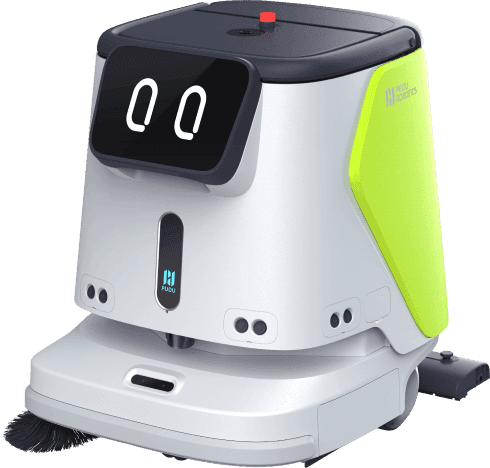
Ask a facility manager what a cleaning robot costs and you'll get the sticker price. Ask a CFO after five years and you'll get a very different number. The purchase price of a PUDU CC1 is real — but it's only about two-thirds of what the machine actually costs to own and run. Here's the whole bill, decomposed.
Why the sticker price lies
The CC1 is a 4-in-1 autonomous scrubber-dryer (sweep, vacuum, mop, scrub) that actually washes hard floors, docks itself to refill water and drain waste, and runs about 5 hours per charge at 70 dB. Its indicative purchase price is ~A$30,100 ex-GST (US$22,000 list, converted at our standard AUD basis).
But a robot isn't a one-off purchase — it's a five-year operating relationship. Alongside the machine you pay to install and map it, to service it, to feed it brushes and detergent, to license the fleet software, and to charge it. None of those lines is large on its own. Together they add roughly A$14,000 across five years — enough to move a payback estimate by months if you ignore them.
The line items
For a representative Australian site — one CC1 cleaning about 1,200 m² a night, 6 nights a week — here's every dollar over a five-year life.
| Cost line | Basis | 5-year total |
|---|---|---|
| Hardware (CC1, ex-GST) | Indicative purchase | A$30,100 |
| Install, mapping & dock | One-off setup | A$1,900 |
| Service & maintenance | ~A$1,200/yr | A$6,000 |
| Consumables (brushes, squeegee, pads, detergent) | ~A$700/yr | A$3,500 |
| Fleet software & connectivity | ~A$400/yr | A$2,000 |
| Energy | ~A$100/yr | A$500 |
| Total cost of ownership | A$44,000 |
The CC1 keeps two of those lines unusually small. It uses about 4 ml of water per m² versus ~100 ml for manual mopping, so detergent and water barely register — the consumables line is dominated by wear parts, not fluids. And a single 1.28 kWh battery pack cleaning ~1,200 m² a night makes energy almost a rounding error.
- Hardware (CC1)68%
- Service & maintenance14%
- Consumables8%
- Software & connectivity5%
- Install & mapping4%
- Energy1%
The machine is 68% of the five-year bill; setup, service, consumables, software and energy make up the other 32%. Budget for all of it — not just the purchase order.
The number that dwarfs all of them
Here's the twist a TCO table alone hides: the whole A$44,000 is small next to the labour the machine displaces. In this site the CC1 removes roughly two of the three hours a person spent mopping each night — a supervisor still handles edges, detail and the occasional flagged exception — which is about A$1,800 a month of gross labour saved. Over five years, that compounds:
Gross labour displaced climbs to ~A$108k over five years — about 2.5× the machine's entire A$44k cost of ownership. The robot is the cheap part.
What that means for payback
Netting the ~A$200/month of running costs against the ~A$1,800/month of labour saved leaves a net saving of ~A$1,600/month. Against the A$32,000 upfront (hardware plus install and mapping), that's a break-even at about 20 months — and everything after is contribution.
Break-even at ~20.0 months on a $32,000 upfront outlay saving $1,600/month.
Run the full five years and the arithmetic is stark: ~A$108,000 of labour displaced against A$44,000 of total ownership cost — a net benefit of about A$64,000 from a single machine.
Three lessons for a TCO that survives review
- Quote the five-year number, not the sticker. A purchase order shows A$30,100; the honest figure your CFO should sign against is A$44,000. The gap is service, consumables, software and energy — predictable, but only if you list them.
- The composition is the same across brands. Whether you shortlist a PUDU CC1, a Gausium scrubber or a CenoBots unit, hardware dominates TCO and running costs land in the same ~30% band. Compare machines on the whole five-year cost, not the price tag — a cheaper robot with a fatter service contract can lose.
- Labour is the line that decides it. Every running-cost line here is dwarfed by the manual hours the robot removes. Get the labour displacement right and the TCO precision matters far less than it feels like it should.
See your own five-year number
The A$44,000 here is one representative site. Yours will differ on floor area, cleaning window, wage rate and how much detail work stays manual.
- Run your site through the Fleet & ROI Planner to see the decomposed TCO and payback on your own numbers.
- Or tell us about your site and we'll send a vendor-neutral shortlist with indicative five-year costs.
Frequently asked questions
- What is the real 5-year cost of owning an autonomous scrubber like the PUDU CC1?
- About A$44,000 all-in for one unit: A$30,100 for the machine, plus roughly A$14,000 of install, service, consumables, software and energy over five years.
- Isn't the purchase price the main cost of a cleaning robot?
- No. Hardware is only about 68% of the five-year total. The other ~32% is setup and running costs, so budget for service, consumables and software from day one — not just the sticker price.
- How long until an autonomous scrubber pays for itself?
- Around 20 months for a single PUDU CC1 in a representative Australian site, once you net all running costs against roughly A$1,800/month of displaced manual cleaning labour.
- Do autonomous scrubbers have high consumable costs?
- They're modest. The PUDU CC1 uses about 4 ml of water per m² (versus ~100 ml mopping by hand), so water and detergent are a tiny line — consumables run around A$700/year.
- Does the machine or the labour dominate the economics?
- The labour. Over five years a single CC1 displaces roughly A$108,000 of manual cleaning — about 2.5× its entire A$44,000 cost of ownership.
Put these numbers to work
See which robot fits your facility and what it would save you.
Run the Fleet & ROI Planner