A 9,000 m² Hospital Night-Clean: Three Scrubbers, One Operator
A composite case study: sizing an autonomous scrubber fleet for a hospital's quiet hours on a uniform spec-derated basis — and an ~11-month payback.
By WhichBot Team
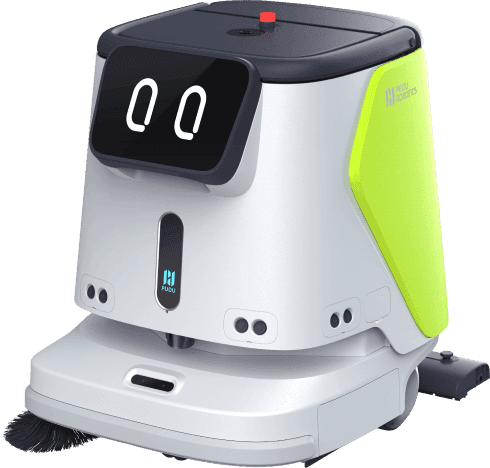
In a hospital, a clean floor isn't presentation — it's infection control. A regional hospital wanted consistent, provable floor coverage across its wards and corridors without adding night labour it couldn't hire. We ran the numbers through the Fleet & ROI Planner and built the plan around three PUDU CC1 autonomous scrubbers.
The brief
The hospital runs 24/7, so there is no "closed" cleaning window — only quieter hours, roughly 21:00 to 06:00. Two things had to be true: the machine must be safe and unobtrusive around people and beds, and coverage had to be provable, not just "we mopped it."
- ~9,000 m² of robot-reachable sealed vinyl and terrazzo — theatres, isolation areas and congested back-of-house stay a specialist manual job
- Corridors, wards, waiting areas, and imaging — mixed traffic all night
- Ward doorways and bed traffic put a hard cap on machine width
- No appetite for a machine that needs a human walking beside it
Where coverage actually leaked
Manual cleaning didn't fail on the main corridors — it failed at the edges and the back-of-house, exactly where a rushed 3 a.m. round cuts corners. Two cleaners on an eight-hour round, at the 400 m²/h we hold manual mopping to, cover about 6,400 m² — roughly 70% of the reachable floor, every night, with the pathology wing and back-of-house drawing the short straw. Mapping the building by zone made the gaps obvious:
Illustrative zone coverage under manual rounds — red, dashed zones fell below target. The dock marker is schematic; the CC1's dock needs a water feed and a floor drain, which fixes where it can go. Zone percentages are representative, not audit data.
The autonomous route doesn't get tired or skip the pathology wing at the end of a long night — which is where the manual round leaked first.
Corridors, waiting areas and ward circulation are the robot's floor. Clinical detail work, isolation areas and the congested back-of-house stay manual — a floor scrubber is a floor-care machine, not an infection-control programme.
The shortlist
This is a wet job — washed floors, not swept — so the screen is the catalogue's autonomous wet scrubbers that fit ward-corridor traffic: we held the line at a 75 cm minimum-aisle figure for door frames and bed movements. We size every machine the same way: manufacturer spec figure (midpoint where a range is published) × a derate × an 85% in-window duty allowance covering docking, water refill/drain and zone transitions. No brand gets a friendlier basis than its own spec sheet earns, and no brand's fleet telemetry is used on its own row. One disclosure, because it is our number and it matters: the 0.6 derate is calibrated from measured PUDU fleet data (output ÷ spec averages 0.59 across five PUDU models with confirmed specs, rounded to 0.6 — a sixth PUDU model, the BG1, sits at 0.20 on a thin sample and an unconfirmed sheet and is excluded, which moves the derate in our recommendation's favour) and then applied to every brand identically; the tighter 0.45 for theoretical-max spec figures has no equivalent calibration — it is a judgement. Both are ours.
Prices are indicative Australian retail, ex-GST.
| Model | Effective coverage | Units (9 h window) | Noise | Indicative price | Fleet cost / year*** |
|---|---|---|---|---|---|
| PUDU CC1 | ~434 m²/h** | 3 | ~70 dB | ~A$30,100 | ~A$18,100 |
| PUDU CC1 Pro | ~434 m²/h** | 3 | ~70 dB | ~A$32,800 | ~A$19,700 |
| Gausium Phantas | ~268 m²/h | 5 | ~60 dB | ~A$44,600 | ~A$74,300 |
| Gausium Mira | ~771 m²/h* | 2 | Not recorded | ~A$49,200 | ~A$32,800 |
Each figure comes off the maker's own published number — with one exception we have to flag, because it decides the table. 434 comes from the CC1 and CC1 Pro's shared 700–1,000 m²/h cover-mode range (midpoint 850), and 268 from the Phantas's 350–700. The exception is the Mira's 771: that derives from a 2,016 m²/h theoretical maximum we compute ourselves, from Gausium's published 400 mm deck at 1.4 m/s, because the top-end we previously held (3,780 m²/h) is inconsistent with that width and speed. Our substitution is material and it runs against the Mira: on 3,780 it sizes to a single unit at ~A$16,400 a year — below the CC1. We think the physics is right, but the row below is ours, not Gausium's, and you should weigh it that way.
A CC1's 5 h battery doesn't span the 9-hour window, so each unit takes one mid-shift top-up — a partial one, about 1.2 h rather than a full 3-hour charge. The sizing above already prices that in (about 7.5 cleaning hours per unit a night).
One more catalogue machine fits the aisle screen but isn't in the table, and you should know why. The CenoBots L3 publishes no runtime or battery figure — our catalogue records that CenoBots doesn't publish them — so a unit count for it would rest partly on our default assumptions rather than its own spec, and we can't responsibly size it; on paper it would be two units and the cheapest capex here, so if you're shortlisting, ask CenoBots for the runtime figure and run it yourself. (The PUDU BG1 is out twice over: its 85 cm minimum aisle fails the 75 cm screen on the figure we hold, and its manual isn't on file either.)
* The Mira's 2,016 m²/h is flagged in our catalogue as a theoretical maximum, so it takes the tighter 0.45 derate; the others take 0.6. We also hold no charge time for it, so the mid-window top-up is modelled at our 3-hour default — though the two-unit count holds at any charge time up to nearly seven hours, so that assumption isn't what decides the row. And we hold no noise figure for it either — a headline requirement in this brief. Fewest units, most gaps in our data.
** The CC1 and CC1 Pro publish the same cover-mode range, so on our uniform basis their throughput is identical — we cannot rank them on speed, and we don't. The Pro adds a faster spot-cleaning mode the uniform basis doesn't credit. What separates them here is price: ~A$2,700 a unit.
*** Hardware capital spread over the service life our planner assumes per brand — five years for PUDU, three for Gausium. That is our planning assumption, not a published vendor warranty, and it moves the answer: levelled at a common five years the column reads CC1 ~A$18,100, CC1 Pro ~A$19,700, Mira ~A$19,700, Phantas ~A$44,600. The prices aren't built the same way either: the PUDU and Phantas figures are US retail listings converted at an indicative FX rate and cut 10%; the Mira figure comes from a second US source, cut the same 10% and then carrying a further +20% uplift of ours before conversion to level its basis — strip that and the Mira is ~A$41,000 a unit and ~A$16,400 a year levelled, the cheapest row here. Trust the ranking only as far as those adjustments deserve.
Why the CC1 anyway? Because every row that undercuts it on paper rests on a number nobody published: the Mira's charge time, noise and theoretical-max coverage; the L3's runtime. The Phantas is the exception — every figure this sizing needs is on its sheet — but it needs five units and lands far up the cost column. So the CC1 and CC1 Pro are the cheapest rows where every figure the sizing needs is published, and between those two, identical throughput makes it a price decision. That is a call about what you can evidence, not a claim that the Gausium or CenoBots machines are worse; on a site willing to get the missing figures from the vendors in writing, the Mira in particular is a genuine contender.
The money
Three CC1 units at A$30,096 each is A$90,288, plus about A$5,700 of mapping and dock plumbing — our own deployment assumption, not a catalogue figure; the CC1's dock auto-refills and drains, which means a water feed and a floor drain at the dock position — for ~A$96,000 upfront. Against it:
- Before: two cleaners × 8 h = 16 crew-hours a night, covering about 6,400 m² of the 9,000
- After: one rostered operator on an 8-hour night — about 2.8 hours of that is exception handling (the fleet spends ~20.8 robot-hours scrubbing, at our published eight exception-minutes per robot cleaning hour; the live planner budgets a flat hour per robot per night instead, which would put it at 3), and the balance goes to the clinical detail work no robot touches
- Net saving 8 crew-hours a night, at A$35/h across a seven-night week (~30 nights a month) ≈ A$8,400 a month
Break-even at about 11 months on ~A$96,000 upfront against ~A$8,400 a month of displaced labour.
Worth being clear about what that return is: every dollar of the ~A$8,400 is displaced rostered labour — two cleaners down to one operator. The bigger gain carries no dollar in the model: the old round covered about 70% of the reachable floor, so the pathology wing and back-of-house went short every night. The fleet buys coverage as much as it displaces wages.
One more line the model doesn't price: water. At the ~4 ml/m² we hold an autonomous scrubber to, 9,000 m² a night is about 36 litres; manual mopping at a typical ~100 ml/m² is closer to 900 litres. In a building that scrubs every night of the year, that difference is real even before you cost it.
Would it work for your site?
- Size your own fleet with the Fleet & ROI Planner — set robot reach to 100%, since the 9,000 m² here is already net of theatres, isolation and back-of-house (the planner's default is 90%).
- Or tell us about your facility for a vendor-neutral shortlist with indicative pricing.
Frequently asked questions
- How many cleaning robots does a hospital wing need?
- In this composite, three PUDU CC1 autonomous scrubbers covered ~9,000 m² of corridors, wards and common areas inside a nine-hour quiet window, each taking one mid-shift charge. On the uniform spec-derated basis we size every brand on, a CC1 plans at about 434 m²/h in-window. Theatres and isolation areas stayed a specialist manual job.
- Are autonomous floor scrubbers safe to run around patients and beds?
- The PUDU CC1 is rated at about 70 dB and runs down to walking-pace speeds with obstacle avoidance; in this composite it worked corridors and ward circulation during quiet hours with one supervisor on shift, not unattended in occupied bays. Where the lowest possible noise matters most, the Gausium Phantas is quieter at ~60 dB.
- What is the payback period for cleaning robots in a hospital?
- About 11 months in this composite: roughly A$96,000 upfront for three units plus mapping and dock plumbing, against about A$8,400 a month in displaced night labour — a two-person night round becoming one operator. The bigger gain, the ~2,600 m² a night that wasn't being reached at all, carries no dollar in that model.
- Do cleaning robots replace hospital cleaning staff?
- They change the shape of the work. In this composite a two-person night round became one operator: about 2.8 hours of exception handling across three robots, with the balance on the clinical detail work, theatres and back-of-house no robot touches.
Put these numbers to work
See which robot fits your facility and what it would save you.
Run the Fleet & ROI Planner