A 3PL Warehouse at Peak: 4 Sweepers, 18,000 m² a Night, 22-Month Payback
A composite case study: sizing a PUDU MT1 Max dry-sweeper fleet for a third-party logistics shed whose cleaning window collapses for 13 weeks every peak — and why the flex came from the window, not the fleet.
By WhichBot Team
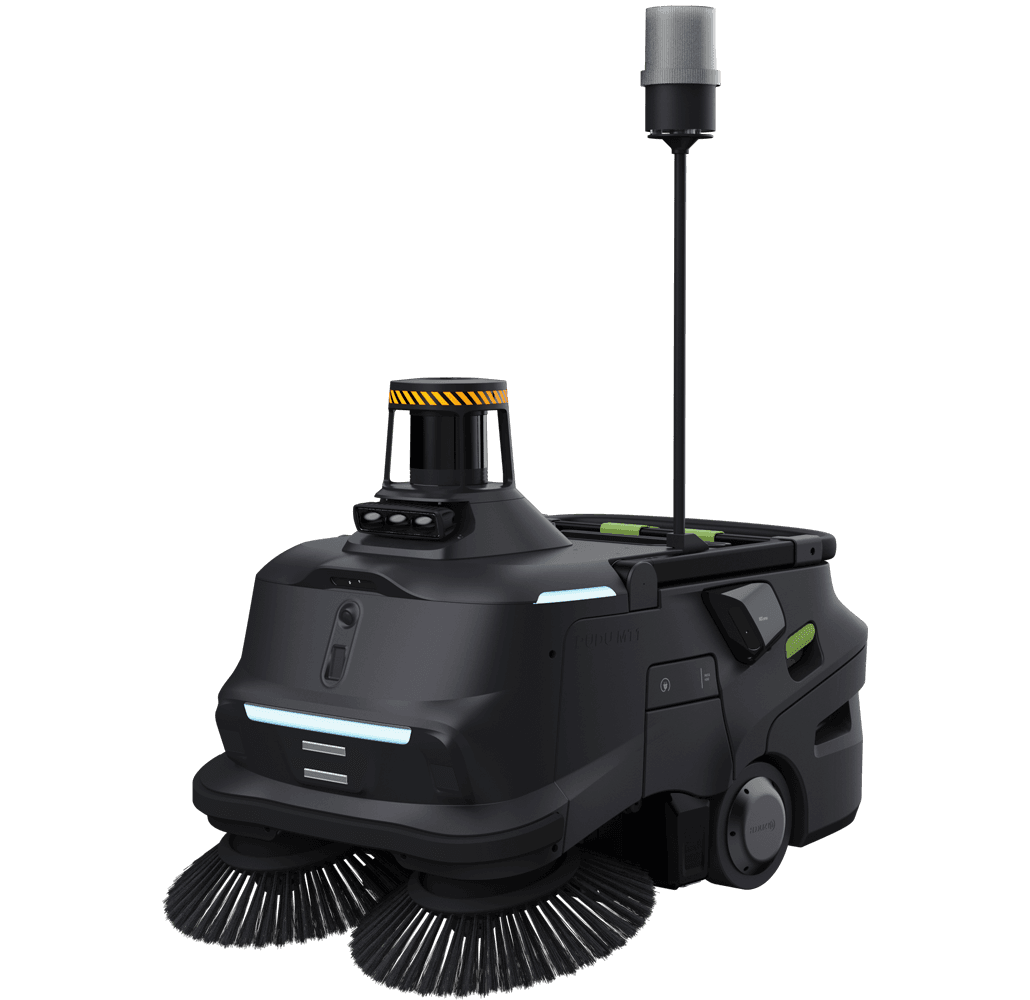
A national third-party logistics operator asked us a seasonal question rather than a robot question: their shed is fine for nine months of the year, and then for about 13 weeks the cleaning window all but disappears. Could an autonomous fleet hold the floor through peak without buying capacity that idles from February to September? We ran the site through the Fleet & ROI Planner. The answer was four PUDU MT1 Max dry sweepers covering 18,000 m² a peak night, paying back in about 22 months — and the cheapest unit of flex turned out to be the window, not the fleet.
The brief
The shed is a 28,000 m² fulfilment and cross-dock facility. About 12,000 m² of that sits under racking or under pallets in the ordinary trading year, and the racked portion no robot will ever touch. What a sweeper can actually reach — main aisles, the cross-aisle spine, pick faces, inbound staging and the dispatch apron — comes to about 16,000 m² in the ordinary trading year, rising to 18,000 m² at peak when overflow marshalling lanes open up on floor that normally sits under stock.
Coverage is what the fleet audits at, not a target. Under-rack and pallet-occupied floor stays a manual job — it is excluded from the 16,000/18,000 m² the robots are sized against.
The constraints were ordinary and unforgiving:
- Dry debris, not spills. Cardboard fines, strapping, shrink-wrap offcuts, pallet splinters and soil tracked in through the dock doors. That is sweeping work; a wet scrubber over dry debris is the wrong machine and a maintenance bill.
- A window that moves with the season. Six clear hours between the last dispatch and the first inbound for most of the year — and about 3.5 hours in a single lull at peak.
- Forklift traffic and speed humps on the dock apron, plus airborne dust that a spray-rated machine isn't built to live in.
- No appetite for capacity that idles. Whatever they bought had to earn its keep in February as well as November.
Why the peak is a window problem
Peak here means roughly 13 weeks where outbound volume runs well above the trading baseline. More cartons out means more corrugate on the floor and a longer dispatch tail — so the dirt goes up exactly as the quiet time goes down.
Peak lifts outbound volume to about 1.7× the March baseline across the 13 weeks, topping out near 1.9× in November. The floor gets dirtier and the clear window gets shorter at the same time — which is what drives fleet size.
Sizing follows the window, not the calendar. On the uniform basis we apply to every brand — manufacturer rated coverage × a 0.6 real-world derate — the MT1 Max works at 1,320 m²/h, and the engine takes a further 15% off for docking, bin changes and zone transitions inside the window. That's about 1,122 m²/h of usable in-window throughput, or 6,732 m² per unit across a 6-hour night and 5,049 m² across a 4.5-hour one.
Same floor, same machine, three different answers. Splitting the peak clean across a 2.5-hour night lull and a 2-hour shift-changeover pass takes one machine out of the fleet — and the capital that goes with it.
That is the whole finding. Fighting for one extra hour of floor time with the operations manager was worth about A$39,000 of capital.
The shortlist
Four dry machines were credible. Every rate below is the manufacturer's rated coverage put through the same derate — 0.6 for a practical published figure, 0.45 where the vendor publishes a theoretical maximum — so nobody is compared on a friendlier basis than anyone else.
| Model | Type | Rate (spec → derated) | Runtime | Unit price | Peak fleet & capex |
|---|---|---|---|---|---|
| PUDU MT1 Max | Dry sweeper | 2,200 → 1,320 m²/h | ~7 h | ~A$39,218 | 4 units · A$156,872 |
| PUDU MT1 | Dry sweeper | 1,800 → 1,080 m²/h | ~6 h | ~A$25,992 | 5 units · A$129,960 |
| Gausium Beetle Pro | Dry sweeper | 3,240* → 1,458 m²/h | ~5 h | ~A$42,680 | 4 units · A$170,720 |
| CenoBots SP50 | Dry sweep + vacuum | 1,987 → 1,192 m²/h | ~8 h | ~A$44,688 | 4 units · A$178,752 |
*published as a theoretical maximum, so it takes the tighter 0.45 derate.
On capex alone the MT1 wins: five units at A$129,960 is A$26,912 cheaper than four MT1 Max. It stayed close all the way to the end. What decided it was the fifth machine's overhead — one more unit to load, empty, check and re-map costs roughly half an hour a night, or about A$455 a month, which is A$27,300 across the five-year amortisation. The capex gap closes to near-nothing, and then the environment breaks the tie: the MT1 Max is rated IP54, the MT1 IPX3. In a shed with airborne corrugate dust, that is not a rounding error.
The money
Four units at ~A$39,218, plus mapping, commissioning and four charge-pile installs at about A$6,350, came to roughly A$163,000.
The baseline it displaces is deliberately conservative. Two casuals spent five hours a night, six nights a week, sweeping the pick aisles and dispatch apron — about 5,000 m² a night at the 500 m²/h hand-sweep rate we hold every manual comparison to. We credit only those 10 hours, less 2 hours of daily robot supervision across the fleet — half an hour per machine — not the notional 32 hours it would take to hand-sweep all 16,000 m². Eight hours a night × 26 nights × A$35/hr fully loaded is about A$7,280 a month — while the audited floor goes from 5,000 m² a night to 16,000.
Break-even at ~22 months on A$163,222 upfront saving A$7,280/month. Peak-season overtime the crew no longer works is upside we left out.
Rent the fourth unit, or buy it?
The instinct with seasonal capacity is to rent. We checked, and the arithmetic went the other way. The shortest rental tier on the Australian price card for an MT1 Max is a 12-month term at A$80/day — about A$29,200 for a year, to cover a 13-week need. Buying the same machine outright is ~A$39,218, and it is there for every peak after this one. Renting only wins when the term actually matches the season; here it didn't, so they bought.
Two other things carried over from the deployment:
- Re-map after the racking moves. Peak layouts change: overflow lanes appear where stock used to sit. A map drawn in September is wrong by November.
- Charge piles go where the aisles converge, not in a corner. The spine position recovered roughly 10% of effective runtime that had been going into dead travel.
At 75 dB the MT1 Max is a fine neighbour in a shed and a poor one on a retail floor — worth remembering if the same fleet is meant to serve both.
Would it work for your site?
It depends on your reachable floor, your window and your wage rates — which is exactly what the planner is for.
- Run your shed through the Fleet & ROI Planner to size it on your own numbers.
- Or tell us about your site and we'll send a vendor-neutral shortlist with indicative pricing.
Frequently asked questions
- What kind of cleaning robot suits a 3PL warehouse floor?
- A dry sweeper, not a wet scrubber. Distribution-centre floors collect dust, cardboard fines, strapping, shrink-wrap offcuts and soil tracked in through the dock doors — dry debris, which is sweeper work. Running a scrubber over it just clogs the recovery path. The PUDU MT1 Max is the dry sweeper we size these sheds with, at a spec-derated 1,320 m²/h.
- How many cleaning robots does a distribution centre need at peak?
- In this composite, four PUDU MT1 Max units covered 18,000 m² of robot-reachable floor inside a split 4.5-hour peak window — about 4,500 m² per unit, against a per-unit window capacity of roughly 5,050 m², on a spec-derated 1,320 m²/h with an 85% in-window duty allowance. In the ordinary trading year the same floor is 16,000 m² in a 6-hour window, which three units clear.
- Should you rent extra cleaning robots for peak season or buy them?
- Check the shortest rental term on offer before you assume renting is the cheap option. The shortest tier on the Australian price card for a PUDU MT1 Max is a 12-month contract at A$80/day — about A$29,200 for the year, against roughly A$39,218 to own the machine outright. If you need the unit every peak, buying wins inside two seasons.
- What's the payback on cleaning robots in a warehouse?
- About 22 months in this scenario: roughly A$163,000 upfront for four PUDU MT1 Max units plus mapping and charge-pile installs, against about A$7,280 a month of displaced night-sweep labour.
- PUDU MT1 or MT1 Max for a warehouse?
- The MT1 is cheaper per machine, but its lower rated coverage needs five units instead of four here (A$129,960 versus A$156,872) — and the extra unit's supervision claws back almost all of that gap over five years. The MT1 Max is also rated IP54 against the MT1's IPX3, which is the tie-breaker in a dusty shed.
Put these numbers to work
See which robot fits your facility and what it would save you.
Run the Fleet & ROI Planner