How a 4,200 m² Data Centre Floor Gets Cleaned Under Escort — on an 18-Month Payback
A composite case study: sizing autonomous scrubbers for a dust-critical colocation site, why the fastest machine on the board loses, and the 18-month payback our Fleet & ROI engine returns.
By WhichBot Team
Worked example. This is an illustrative composite of a mid-size colocation data centre — no named customer. The floor area, shortlist and fleet sizing are modelled through our Fleet & ROI Planner on indicative pricing, sizing every brand on the same spec-derated basis; the labour baseline is this site's roster figure. It shows the shape of the decision, not a specific quote. To reproduce the table below: enter 4,200 m², set Robot reach to 100% (we have already netted off the floor a wheeled machine can't get to) and Deployment to full coverage. The dry MT1 Vac and the mop-only L3 sit in different cleaning modes, so we ran Sweep and Mop separately and combined the rows — the sizing basis is identical in both.
Australia is building data centres faster than it is building the crews to keep them clean. Industry pipeline analysis in mid-2026 put roughly 1,850 MW across about 19 sites under construction, concentrated in just a handful of western-Sydney and western-Melbourne suburbs — a boom narrow enough that it is effectively a two-suburb story. Every one of those sites needs a floor-cleaning regime that survives a hygiene audit while a security escort watches the clock. So we took a composite colocation site and asked the unglamorous question: can a robot do the boring half?

The brief
Dust in a data hall is mostly imported. It walks in on shoes, sheds off cardboard in the de-box room, blows in through the loading dock — then the CRAC fans distribute it. The site's contract already covered a periodic ISO 14644-1 Class 8 technical clean of the white space: specialist hand work on the plenum, cabinet interiors and above-ceiling void, under ESD protocols. What it covered badly was the frequent, boring job — the 4,200 m² of hard floor around it, where the dust budget comes from.
That 4,200 m² is what a wheeled robot can reach on one level: loading dock apron, de-box and staging rooms, circulation corridors, meet-me-room and carrier corridors, NOC and office floors, and the cold aisles of two data halls. Excluded and still manual: the subfloor plenum, cabinet interiors, and any gap narrower than the CC1's 70 cm minimum aisle.
The constraints make data centres different:
- Escorted access. A six-hour window (about 11pm to 5am), five nights a week, with a security escort present. Every extra machine costs escort time.
- Dust is the product defect. Cleaning has to remove particulate, not redistribute it — which rules out anything that only mops.
- Raised-floor access ramps and 20 mm threshold lips between zones.
- Single level. The CC1 has no lift integration in our catalogue; this site's cleanable floor is on one level anyway.
The shortlist
We compared four machines on the same basis — manufacturer spec discounted to a real-world rate, as the planner does — then sized each to the window.
| Model | Type | Effective rate* | Units here | Indicative fleet capex |
|---|---|---|---|---|
| PUDU CC1 | Wet 4-in-1 (sweep + vacuum + mop + scrub) | ~434 m²/h | 2 | A$60,192 |
| PUDU MT1 Vac | Dry sweeper + HEPA vacuum | ~714 m²/h | 2 | A$57,456 |
| CenoBots L3 | Wet scrubber (mop + scrub only) | ~771 m²/h | 2 | A$65,664 |
| Gausium Phantas | Wet 4-in-1 | ~268 m²/h | 3 | A$133,791 |
*Effective rate = manufacturer spec × uniform derate × 0.85 window duty — the same engine basis for every brand. The derate follows our catalogue's coverageBasis flag: a figure the vendor publishes as a bare theoretical maximum takes the tighter 0.45 (here, only the CenoBots L3's 2,016 m²/h); everything else takes 0.60. That flag is a judgement call about how each vendor writes its numbers, and it moves the answer — worth knowing it's there. Fleet capex = indicative unit price (A$30,096 / A$28,728 / A$32,832 / A$44,597 ex-GST) × units.
Three of the four need two units, because the sizing constraint is the six-hour window, not the headline clean rate. The Phantas needs three: its 350–700 m²/h range derates to the lowest effective rate on the board.
The CenoBots L3 posts the highest effective rate here and is the wrong machine anyway: it only mops and scrubs. On a floor whose whole problem is settled particulate, a wet-only pass makes slurry and pushes it to the edges. It also has no auto refill/drain dock and publishes no runtime figure, so the engine sizes it on a conservative default — and it still needs two units.
The PUDU MT1 Vac is the near-miss, and the cheapest fleet on the board: a dry machine with a published HEPA filter, the only one here. Had this site's spec said "vacuum, don't wet", it would have won. It didn't — the NOC, amenities and de-box floors need an actual wash, and running a dry fleet and a wet fleet doubles the docks and the escorted trips. It also needs the most room to turn: 75 cm of aisle to the CC1's 70.
The Gausium Phantas has two advantages we'd be wrong to bury. It gets into a 65 cm aisle — narrower than the CC1 or the L3, which both need 70 — so it would reach a little more of this floor than our winner. And of the two machines here that publish a noise figure, it's the quieter: 60 dB to the CC1's 70 dB. In a hotel lobby that decides the purchase; beside a row of CRAC fans it buys nothing. Three units at A$44,597 each is a A$133,791 fleet — 2.2× the CC1 pair.
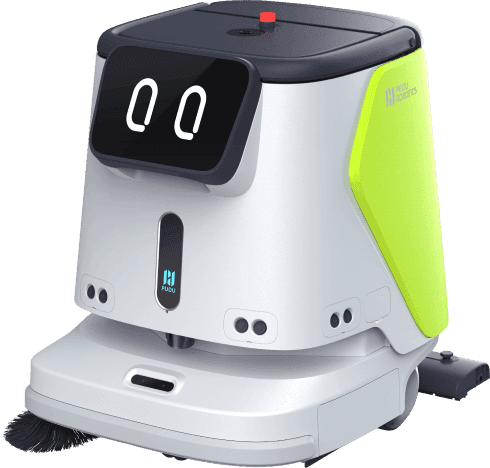
That leaves the PUDU CC1: it lifts debris dry before it wets the floor, docks itself to refill, drain and dose, and two units finish inside the window with no mid-shift recharge. It isn't the cheapest — A$2,736 more than the MT1 Vac pair — and at 434 m²/h it is the slowest of the three that clear this floor in two units. It's the one that matches the job.
The coverage plan
Each CC1 takes 2,100 m², working outward from an auto water dock in grey space where water and a drain already exist. At 434 m²/h that's a ~4.8-hour run, inside the CC1's ~5-hour battery — no mid-window recharge.
The robots drive all 4,200 m² every night — that is the sizing basis. The percentages are what a floor audit then finds properly covered within each zone: a 500 mm deck can't get into cabinet feet or containment-door thresholds, so the cabinet-dense halls carry most of the shortfall. That residual perimeter already sat in the site's standing periodic manual scope — the same visit that covers the plenum, the cabinet interiors and any gap under 70 cm — rather than in the nightly round. It is therefore outside the labour comparison below on both sides of it: it is not work the escorted crew was doing at 52% of a thorough pass, and it is not work the robots are credited with.
- Badge-in & escort~11pm — security walk, halls confirmed
- Grey space firstdock, de-box, corridors — where dust enters
- Hall cold aislesdry pickup then damp pass, escort present
- Auto dockrefill, drain, recharge
- Handover log~5am — coverage report to the NOC
The money
A thorough hand-clean of 4,200 m² takes about 10.5 hours at the planner's manual wet-clean rate of 400 m²/h. The escorted crew was logging roughly 5.5 hours a night — barely more than half a thorough pass, with the loading dock apron and the far carrier corridor the reliable casualties. That 5.5 hours is this site's roster figure, not an engine output; the sizing is what the planner computes.
With two CC1s working the full envelope, attended time drops to about 1.5 hours a night — escort duty, dock checks and the occasional flagged obstruction. (The planner's documented supervision assumption of 8 minutes per robot-hour puts that at ~1.3 hours; the balance is escorted-access overhead. Edge detailing is not in there — it stays on the periodic manual visit, as before.) That's 4.0 net hours a night displaced, across 260 escorted nights a year — about 21.7 a month — at a fully-loaded A$38/hour for security-cleared staff:
A$60,192 upfront ÷ ~A$3,300 net monthly saving — break-even at about 18 months.
The estimate was right on labour and understated consistency. The floor the crew skipped at 3am was the loading dock apron — where the dust that reaches Hall B comes from. Cleaning it nightly did more for the quarterly particulate count than anything the robot did inside the halls.
What carried over
- Clean the grey space to protect the white space. The highest-value floor a robot cleans is the one nobody audits — the dock, the de-box room, the corridor outside the hall door.
- Dry pickup before the damp pass, or don't bother. In a dust-critical environment, mop-only is worse than nothing.
- A robot is not a certification. Nothing in our catalogue carries an ISO 14644 class or an ESD rating. Keep the technical clean manual; give the robot the frequent, boring, escorted work it can actually finish.
Would it work for your site?
The honest answer is "it depends on your reachable floor area, your window and your wage rates" — which is what the planner is for.
- Run your own facility through the Fleet & ROI Planner to see the payback on your numbers.
- Or tell us about your site and we'll send a vendor-neutral shortlist with indicative pricing.
Frequently asked questions
- Can a cleaning robot work inside a data centre?
- On the hard floors, yes — the loading dock, de-box and staging rooms, circulation corridors and the cold-aisle floors of the data halls, under escort and to the operator's own housekeeping spec. The ISO 14644-1 Class 8 technical clean of the raised-floor plenum, cabinet interiors and above-ceiling void stays a specialist manual job. No robot in our catalogue publishes an ISO 14644 classification, so a robot supplements that work rather than replacing it.
- Is the PUDU CC1 rated for cleanrooms or ESD environments?
- No. The only environmental rating PUDU publishes for the CC1 is IPX4 (water ingress). There is no ISO 14644 cleanroom class, no ESD/anti-static certificate and no operating-temperature figure in its spec. Treat it as a commercial hard-floor scrubber that works to your housekeeping spec under escort — not a cleanroom-certified machine.
- What kind of cleaning robot suits a dust-critical data centre floor?
- One that picks debris up dry before it wets the floor. A mop-only scrubber turns settled dust into slurry and redeposits it at the edges; a dry-only sweeper leaves the fine residue that a damp pass removes. The PUDU CC1 sweeps and vacuums, then mops and scrubs, in the same pass — which is why it won this shortlist at an effective 434 m²/h, despite two faster machines being on the board.
- How many cleaning robots does a data centre need?
- In this composite colocation site, two PUDU CC1 units clear 4,200 m² of robot-reachable hard floor inside a six-hour escorted window, each working at an effective 434 m²/h (700–1,000 m²/h spec × 0.6 derate × 0.85 window duty) and finishing a ~4.8-hour run inside its ~5-hour battery.
- What's the payback on cleaning robots in a data centre?
- About 18 months in this composite — A$60,192 for two PUDU CC1 units against roughly A$3,300 a month of displaced escorted hard-floor labour. Escorted night work carries a higher fully-loaded wage than ordinary commercial cleaning, which shortens payback relative to a retail site of the same size.
Put these numbers to work
See which robot fits your facility and what it would save you.
Run the Fleet & ROI Planner