24 Quick-Service Sites, Two Cleaning Robots — Neither in a Restaurant
A composite case study: we ran a 24-site Australian QSR estate through the Fleet & ROI engine on one uniform basis. Twenty-two restaurants sat below the 200 m² break-even; the chain's commissary cleared a 17-month payback on two PUDU CC1s.
By WhichBot Team
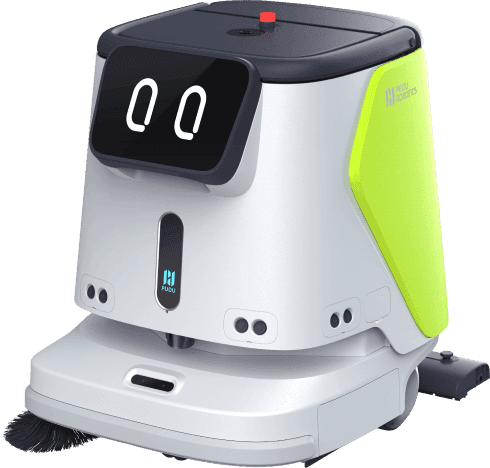
Worked example. This is an illustrative composite of an Australian quick-service chain — no named customer. Site formats and floor areas are modelled through our Fleet & ROI Planner on indicative pricing, sizing every brand on the same spec-derated basis. To reproduce the tables: run wet-clean mode, set Robot reach to 100% (we have already netted off the floor a wheeled machine can't get to) and Deployment to full coverage. Restaurants run 364 cleans a year, the commissary 260. Labour is a fully-loaded A$35/hour throughout.
Twenty-two of this chain's 24 sites cannot justify a cleaning robot, and the arithmetic isn't close. A machine needs roughly 200 m² of robot-reachable floor just to break even against the time someone spends attending it — and the standard Australian QSR building is about 250–300 m² gross, of which barely 120 m² is floor a robot can reach. The two robots this estate should buy both go to the site nobody calls a restaurant.
The brief
The chain runs 22 restaurants, one commissary that preps and packs for all of them, and one ambient distribution centre. Wages are the one big controllable line in a QSR P&L, so the brief was reasonable: where does a floor robot pay?
The restaurants come in four formats. Robot-reachable floor is what's left after the kitchen line (congested, drained, full of sub-70 cm gaps the CC1 can't enter) and the furniture-blocked strip under fixed booths come out:
| Format | Sites | Robot-reachable floor | Nightly hand-mopping |
|---|---|---|---|
| Delivery-led small format | 3 | ~55 m² | ~8 min |
| Shopping-centre food-court tenancy | 4 | ~45 m² | ~7 min |
| Standard suburban drive-thru | 12 | ~120 m² | ~18 min |
| 24-hour highway flagship | 3 | ~240 m² | ~36 min |
| Commissary production & packing | 1 | ~2,300 m² | ~5 h 45 min |
That last column is the whole article. At the planner's manual wet-clean rate of 400 m²/h, a drive-thru's entire nightly mop is eighteen minutes. There is nothing there for a A$30,096 machine to displace.
- Commissary (1 site)48%
- Drive-thru (12 sites)30%
- Highway flagship (3 sites)15%
- Food-court tenancy (4 sites)4%
- Small format (3 sites)3%
One site holds 48% of the chain's robot-cleanable wet floor. The 24th site — the ambient DC — is excluded: a dry, dusty warehouse floor is a dry-sweeper question (the MT1 family), not a scrubber one.
Where the money isn't
We ran every format on the same basis: one PUDU CC1 at an effective 434 m²/h (700–1,000 m²/h spec × 0.6 derate × 0.85 window duty), 0.5 h/day of attended time, A$35/hour fully loaded.
Three formats sit below the ~200 m² break-even: cleaning them by hand takes less time than attending the robot, so net labour saved is zero. The highway flagship saves A$1,274/yr — a 283-month payback on one A$30,096 unit. Only the commissary clears the bar, and it is the only bar sized to two units; every restaurant format needs one.
The obvious objection is that 0.5 h/day of attended time is punitive on a small site. It is — deliberately. So we re-ran it at the planner's own documented supervision assumption of 8 minutes per robot cleaning hour, which on a 120 m² floor is under three minutes a night. The drive-thru payback moves from never to 108 months. The highway flagship moves to 54 months. The commissary moves from 17 months to 16. The assumption we were accused of rigging changes nothing about the answer.
The shortlist — for the one site that qualifies
The commissary floor is wet food-production: flour and packaging debris dry on the ground, grease and product residue on top of it. That combination rules out mop-only machines, which turn dry debris into slurry and push it to the kerbs. The sanitation window is three hours between the late production shift and the morning line.
| Model | Type | Effective rate* | Units | Indicative fleet capex |
|---|---|---|---|---|
| PUDU CC1 | Wet 4-in-1: sweep + vacuum + mop + scrub | ~434 m²/h | 2 | A$60,192 |
| PUDU CC1 Pro | Wet 4-in-1, same hardware | ~434 m²/h | 2 | A$65,664 |
| CenoBots L3 | Wet scrubber — mop + scrub only | ~771 m²/h | 1 | A$32,832 |
| Gausium Scrubber 50 Pro | Wet 3-in-1: sweep + mop + scrub | ~459 m²/h | 2 | A$141,178 |
*Effective rate = manufacturer spec × uniform derate × 0.85 window duty — the same engine basis for every brand. Vendors that publish a bare theoretical maximum take the tighter 0.45 derate (here, only the CenoBots L3's 2,016 m²/h); practical ranges take 0.60. Unit prices A$30,096 / A$32,832 / A$32,832 / A$70,589 ex-GST.
PUDU CC1 Pro is the cleanest illustration of why the basis matters. It shares the CC1's 700–1,000 m²/h cover-cleaning spec, so on our uniform basis the two size identically — same two units, same 2.65-hour run. Its extra spot-cleaning mode is real, but it doesn't change the daily sizing, and it costs A$5,472 more across the pair.
CenoBots L3 is the cheapest fleet on the board and the wrong machine anyway. It only mops and scrubs, on a floor whose first problem is dry debris. Its single-unit answer is also thin: capacity clears 2,300 m² by just 13 m² — a 0.6% margin, and one slow night means it doesn't finish. (CenoBots publishes no runtime figure, so the engine falls back to a conservative default; here the three-hour window binds first, so that gap doesn't move the sizing either way.)
Gausium Scrubber 50 Pro is a genuine peer with a real advantage we shouldn't bury: lift integration, which the CC1 lacks — both machines dock for auto refill and drain. At A$70,589 a unit, that costs A$80,986 more than the CC1 pair for a single-level floor that never uses it. Gausium's Phantas is also the quietest wet machine we list at 60 dB against the CC1's 70 — which would matter in a dining room, and doesn't in a production hall at 2am.
The money
Two CC1s take 1,150 m² each, a ~2.65-hour run inside both the three-hour window and the CC1's ~5-hour battery — no mid-window recharge. A thorough hand pass of 2,300 m² is 5.75 hours; across 260 production nights that's 1,495 hours a year. Attended time is 260 hours (0.5 h/night per robot), leaving 1,235 hours displaced at A$35 — A$43,225 a year, or A$3,602 a month.
A$60,192 upfront ÷ ~A$3,602 net monthly saving — break-even at about 17 months.
What the other 22 sites got
Not a robot. For floors under ~200 m² the honest tool is a walk-behind: the PUDU SH1 at A$5,198 is a compact upright scrubber that washes and dries in one pass. It is not autonomous — an operator pushes it for the entire run — so it displaces no closing-shift labour and we quote no payback on it. It makes eighteen minutes of mopping into a faster eighteen minutes, on a floor that comes up cleaner. That is a real but modest win, and it should be bought as equipment, not as an ROI case.
Three things carried over:
- Size the estate, not the site. A chain's floor area is wildly concentrated. Counting sites told us 24; counting square metres told us one.
- Attended time is the binding constraint on small floors, not clean rate. Below the break-even, a faster robot makes the answer worse, not better.
- A robot is not a sanitation regime. The CC1 does the bulk floor wash; chemical dosing, kerbs, drains and verification swabs stayed with the crew.
Would it work for your estate?
The honest answer depends on your reachable floor area, your window and your wage rates — which is what the planner is for.
- Run your sites through the Fleet & ROI Planner to see which ones clear the bar on your numbers.
- Or tell us about your estate and we'll send a vendor-neutral shortlist with indicative pricing.
Frequently asked questions
- Can a cleaning robot pay for itself in a single quick-service restaurant?
- In Australia, almost never. A standard suburban drive-thru building runs about 250–300 m² gross, which leaves roughly 120 m² of floor a wheeled machine can actually reach — about 18 minutes of hand-mopping a night at the planner's 400 m²/h manual wet rate. There is not enough nightly mopping in one restaurant for a A$30,096 machine to displace.
- How much floor does an autonomous scrubber need before it breaks even?
- About 200 m² of robot-reachable hard floor just to break even against 0.5 h/day of attended time, at the planner's 400 m²/h manual wet-clean rate. For a 24-month payback on a PUDU CC1 at A$30,096 and a fully-loaded A$35/hour, you need roughly 670 m² cleaned daily — three to six times a typical QSR dining room.
- What's the payback on cleaning robots for a quick-service restaurant chain?
- About 17 months in this composite — but at the commissary, not the restaurants. Two PUDU CC1 units at A$60,192 displace roughly A$3,602 a month of night sanitation labour across a 2,300 m² production and packing floor. All 22 restaurants in the same estate returned no positive payback at all.
- What kind of cleaning robot suits a food-production or commissary floor?
- A wet scrubber that lifts dry debris before it wets the floor. The PUDU CC1 sweeps, vacuums, mops and scrubs in one pass, which is why it won this shortlist at an effective 434 m²/h despite a faster machine being on the board. The verified sanitation regime — chemical dosing, kerbs, drains, swabs — stays a manual job.
- Is a walk-behind scrubber a better fit than a robot for a small restaurant?
- For floors under about 200 m² it is the more honest tool, but it is not a labour-saving robot. The PUDU SH1 (A$5,198) is operator-pushed and non-autonomous — a person drives it for the whole run — so it does not displace the closing shift. It only makes that shift's mopping faster, and we do not quote a payback on it.
Put these numbers to work
See which robot fits your facility and what it would save you.
Run the Fleet & ROI Planner