What We Learned Deploying Sweepers Across a 40,000 m² Warehouse
A composite case study of a six-robot sweeper rollout in a distribution centre — the shortlist on a uniform basis, the payback math, and the operational habits that made it stick.
By WhichBot Team
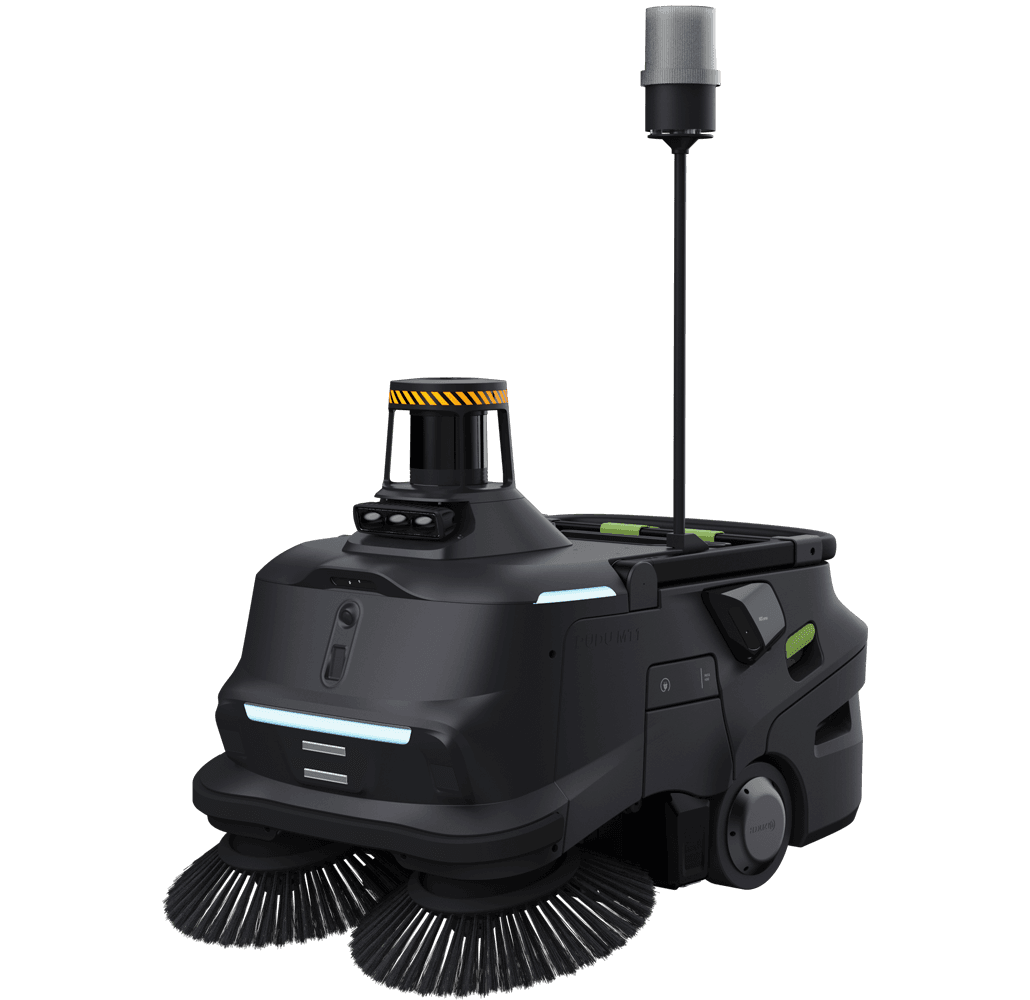
Specs get you to a shortlist. Operations decide whether a fleet survives its first quarter. This is a composite of what we've seen rolling autonomous sweepers into a 40,000 m² distribution centre that went from a four-person night crew pushing walk-behind sweepers to a fleet of six autonomous PUDU MT1 Max units — the shortlist, the money, and the habits that separated the wins from the write-offs.
The site
A regional distribution centre running two shifts, with a six-hour overnight cleaning window between the late pick wave and the early forklift start. Four casual staff pushed walk-behind sweepers across the main aisles — and quietly skipped the perimeter and staging zones when the pick wave ran long.
The constraints were the usual warehouse mix:
- ~34,000 m² of robot-reachable sealed concrete out of a 40,000 m² gross footprint (racking, tight corners and dock-leveller pits stay a manual job)
- A 6-hour overnight window before the early-shift forklifts start moving
- Long straight aisles (great for autonomy) but constantly-changing pallet layouts (murder for a stale map)
- Mixed traffic: the cleaning window overlaps with restock, so obstacle avoidance had to be genuinely reliable
The honest starting point: four people at the 500 m²/h we hold every manual sweeper to covered about 12,000 m² a night — barely more than a third of the reachable floor. The fleet wasn't replacing a clean floor. It was buying one.
The shortlist
We size every machine the same way: manufacturer spec figure (midpoint where a range is published) × a derate × an 85% in-window duty allowance. No brand gets a friendlier basis than another. The 0.6 derate itself is calibrated from measured PUDU fleet data — the only place telemetry enters the sizing math for a dry fleet (the engine's one other fleet-calibrated constant is a water figure a sweeper never touches; and the 0.59 average is across the five PUDU models with confirmed specs — a sixth, the BG1, sits at 0.20 on a thin sample and is excluded, which moves the derate in our recommendation's favour) — and it is then applied to every brand equally, never to flatter the sheet it came from. (Re-size PUDU on its own measured ratios and the counts don't move: MT1 Max still six, MT1 still seven.)
| Model | Effective coverage | Runtime | Ingress | Indicative price | Units to clear 34,000 m² | Fleet cost / year |
|---|---|---|---|---|---|---|
| PUDU MT1 Max | ~1,122 m²/h | ~7 h | IP54 | ~A$39,200 | 6 | ~A$47,100 |
| PUDU MT1 | ~918 m²/h | ~6 h | IPX3 | ~A$26,000 | 7 | ~A$36,400 |
| Gausium Beetle Pro | ~1,239 m²/h* | ~5 h | None recorded | ~A$42,700 | 5 | ~A$71,100 |
| CenoBots SP50 | ~1,013 m²/h** | ~8 h | None recorded | ~A$44,700 | 6 | ~A$134,100 |
Those are post-derate, post-duty rates, so you can check the sizing yourself. Each comes off the maker's own published figure: 1,122 from PUDU's 2,200 m²/h cover-mode rate, 918 from the MT1's 1,800, 1,239 from the Beetle Pro's 3,240 theoretical maximum, and 1,013 from the SP50's 1,987 full-coverage figure. Multiply by the hours a machine can actually clean inside the window — the MT1 Max manages the full six, so 1,122 × 6 = 6,732 m² a night and six units clear 34,000 m². Of the four, only the Beetle Pro's battery falls short of the window; price in a mid-window top-up charge and it gets about 5.7 cleaning hours, or 7,023 m².
“None recorded” in the ingress column means exactly that — our catalogue holds no rating for those two. Our PUDU rows mostly annotate a blank as not published by PUDU; for the other brands — and for PUDU where we don't hold the manual — it is simply a gap in our data. Either way, read it as unknown, not absent.
We screened to dry sweepers — sealed concrete with no floor drain rules out a wet dock — which is all six dry machines in our catalogue, the ones its dry filter returns. The two not shown, the PUDU MT1 Vac and the Gausium Vacuum 40, size to nine and twenty-four units on this floor. They're off the shortlist on the same arithmetic, not by selection.
* The Beetle Pro's 3,240 m²/h is flagged in our catalogue as a theoretical maximum rather than a practical rate, so it takes the tighter 0.45 derate; the other three take 0.6. That flag is our judgement about how each vendor writes its numbers, not the vendor's own label. At 0.6 the Beetle Pro would size to four units and ~A$56,900 a year — still above the MT1 Max. But move both of our constants at once (0.6 derate and the common five-year life below) and the Beetle Pro fleet becomes the cheapest in the piece at ~A$34,100 a year, under even seven MT1. Which is precisely why we didn't decide on cost.
** The SP50's specs are flagged unconfirmed in our catalogue and it is currently limited availability — treat that row as indicative. Its coverage figure is also the only CenoBots one we treat as a practical rate rather than a theoretical max; on the tighter 0.45 derate it would size to eight units and ~A$178,800 a year, further from the MT1 Max, not closer.
“Fleet cost / year” spreads each fleet's hardware capital — mapping and commissioning excluded, since that is site cost, not a brand difference — over the service life our planner assumes for that brand: five years for PUDU, three for Gausium, two for CenoBots. That is our planning assumption, not a published vendor warranty, and it is the biggest lever in the column. Confirm the service terms you can actually get before you lean on it.
Every price here is an estimate, not a quote, and they aren't all built the same way: the MT1 Max figure comes off an Australian distributor card; the MT1 and Gausium figures are converted US retail listings; the CenoBots figure is a US-dollar number quoted in third-party coverage rather than a retailer list, thinner provenance again. All four carry an adjustment of ours, and you should know which way each cuts. The three US-converted figures are taken at 90% of list, which makes every rival ~10% cheaper than its sticker — that cuts against the machine we chose. So does the +5% on the MT1 Max's card price. The Gausium figure takes a further +20% before conversion, because that source's Gausium prices run about 20% under the basis the other rows use — we have not config-matched this model individually — and that one cuts for it. Strip the +20% and the Beetle Pro fleet is ~A$35,600 a year on a common five-year life, not the ~A$42,700 above (the same number as its unit price only because five units over five years divide out). Trust the ranking, not the dollars.
Here is what decided it, and none of it was the headline clean rate:
- The cheapest fleet per year was one we didn't buy. Seven MT1 units come in at ~A$36,400 a year, about A$10,700 less than six MT1 Max. But the MT1 is rated IPX3 — spray-resistant, with no declared dust protection — and this floor generates cardboard fines all night.
- We didn't decide on the annual-cost column, because it rests on our own assumptions. Level every brand at a common five-year life and the ranking moves: the Beetle Pro fleet lands at ~A$42,700 a year, below the MT1 Max's ~A$47,100 — and ~A$35,600 if you also strip our +20% Gausium adjustment. The SP50's A$134,100 is mostly our two-year life; levelled it is ~A$53,600, near the MT1 Max rather than three times it. Any argument that flips when you change one of your own planning constants isn't the argument to buy on.
- What decided it was ingress — as a documentation risk, not a proven gap. The MT1 Max is the only machine here whose dust protection is on paper at all: IP54. The MT1 publishes IPX3 — a water-only rating; the X is the standard's marker for a digit the maker hasn't specified, so its dust protection is undeclared, not zero. On the evidence the MT1 sits with the Beetle Pro, the SP50, the MT1 Vac and the Vacuum 40, not above them: for all five we have no dust figure on file, that is unknown rather than absent, and any of them may well be sealed perfectly well. On a floor that makes airborne fines all night we weren't willing to buy on an undocumented digit. That is a call about what you can evidence before you sign — and unlike the money, it doesn't move when one of our assumptions does.
- Runtime headroom, with the caveat. The MT1's 6 h sits exactly on the window, so there's no reserve for a night that overruns; the MT1 Max's 7 h leaves an hour of it. Neither is a point spec: the MT1's 6 h is the midpoint of its manual's 4–8 h range, and we hold the MT1 Max's 5–10 h at a conservative 7 h. This is a battery-margin call, not a throughput one — the 85% duty allowance above already prices routine docking and transitions for every machine. The SP50's 8 h is longer still — it's ruled out on unconfirmed specs, limited availability and no ingress rating on file, not really on cost and not on runtime.
Five units pay back fastest on paper — but clear 33,660 of 34,000 m², leaving a ~40-minute manual top-up every night and no margin when a night runs long. Six clear the reachable floor without a top-up, which is what the project was actually for. A seventh buys nothing and just adds capital.
The money
Six MT1 Max units at A$39,218 each is A$235,308, plus about A$9,500 of mapping and commissioning — our own deployment assumption, not a catalogue figure — for ~A$244,800. Against it:
- Before: four casuals × 6 h = 24 crew-hours a night
- After: one rostered operator on the same 6-hour window — about 4 hours of that is exception handling (the fleet spends ~30 robot-hours cleaning, at eight exception-minutes per robot cleaning hour), and the balance goes to the racking and corners no robot reaches, worked on a rotation — which is more than the old crew managed, since their 24 hours went entirely on the aisles
- Net saving 18 crew-hours a night, at A$35/h across 26 nights ≈ A$16,400 a month
Break-even at about 15 months on ~A$244,800 upfront against ~A$16,400 a month of displaced labour. Charge supervision at the planner's own default of an hour per robot per night instead of our ~4 hours across the fleet and it stretches to about 17.
The pre-deployment estimate from the Fleet & ROI Planner ran a long way ahead of this, and it's worth understanding why. The planner prices the manual cost of the entire reachable floor — 34,000 m² at 500 m²/h is 68 crew-hours a night. This site only ever paid for 24. Everything above is capped at the crew actually on the roster, which is the number finance will hold you to.
That gap is the real lesson. Every dollar of the ~A$16,400 is displaced rostered labour — 24 crew-hours a night down to 6. The bigger gain, the ~22,000 m² a night that wasn't being cleaned at all, carries no dollar in the model; it shows up as coverage, not as return. If your night crew genuinely covers the floor already, the labour line is bigger and the payback is shorter; if it doesn't, you're buying a clean floor and the payback is slower than any calculator will tell you. Run your own numbers rather than borrowing a case study's.
What no payback model captures: the value of a floor that gets the same pass every night rather than the pass a tired crew has time for at 3 a.m. We don't put a dollar on it, and neither should a business case that has to survive a CFO — but it is the reason the operations team stopped arguing about the capital line.
Four lessons that decided the rollout
1. Mapping is 80% of the install
The robots cleaned beautifully on day one — on the aisles that were mapped. The problems were everywhere the map was stale: a relocated pallet rack, a new charging cart, a seasonal staging zone. Budget re-mapping as an ongoing operational task, not a one-time setup.
2. Dock placement is a floor-planning problem
At 7 h of runtime against a 6 h window, the MT1 Max never needs a mid-window recharge — so charging was never the constraint. Travel to and from the dock was. Docks clustered in one corner meant every robot burned window time crossing the shed to start and finish. Moving docks to the centroid of each cleaning zone recovers most of the 15% the 85% in-window duty allowance above sets aside for docking and zone transitions. Leave the docks in one corner and you fall below that allowance, and the sizing above stops holding.
3. The "exception queue" is the real job
Autonomy doesn't remove labour; it changes its shape. The night team stopped pushing a sweeper and started managing exceptions: a spill it can't clean and won't drive through, a blocked aisle, a full debris hopper. One trained operator handled all six robots — but only after we built a simple exception dashboard and a clear escalation rule.
4. Instrument it or you're guessing
The teams that win assign an owner and measure the work: window completion rate, exceptions per night, kilograms of debris per 1,000 m². Without that, you can't tell a mapping problem from a hardware problem — and you'll blame the robot for a floor-planning miss.
The takeaway
If you're rolling out more than one robot, treat it as an operations program, not a purchase. Assign an owner, instrument the work, and re-map relentlessly.
- Size your own fleet with the Fleet & ROI Planner to see the payback on your floor area and window.
- Or tell us about your facility and we'll send a vendor-neutral shortlist with indicative pricing.
Frequently asked questions
- How many cleaning robots does a 40,000 m² warehouse need?
- In this composite, six PUDU MT1 Max units cleared 34,000 m² of robot-reachable floor in a 6-hour overnight window. On a spec-derated 1,320 m²/h with an 85% in-window duty allowance each unit plans at about 1,122 m²/h, or 6,732 m² a night. Five units fall 340 m² short and leave a nightly manual top-up.
- What is the payback on a warehouse cleaning robot fleet?
- About 15 months in this composite: ~A$244,800 upfront for six units plus mapping, against ~A$16,400 a month in displaced labour (a four-person night crew down to one operator). The bigger gain — the floor the site was not cleaning at all — carries no dollar in that model; it shows up as coverage. If your night crew already finishes the floor, the labour line is bigger and the payback is shorter.
- Which cleaning robot is best for a dusty distribution centre?
- Ingress protection matters more than clean rate. The PUDU MT1 Max is the only machine on our dry-sweeper shortlist with a published dust rating (IP54). The MT1's IPX3 rates water only and leaves the dust digit unspecified, and our catalogue holds no rating for the Gausium Beetle Pro or CenoBots SP50 — in all three cases unknown rather than absent. On annual cost the MT1 is cheaper.
- Do cleaning robots replace warehouse cleaning staff?
- They change the shape of the work. In this composite a four-person night crew became one rostered operator: about four hours of exception handling across the fleet, with the balance on racking, corners and dock pits no robot reaches.
Put these numbers to work
See which robot fits your facility and what it would save you.
Run the Fleet & ROI Planner