How an 8-Screen Multiplex Cleans Its Floors Overnight on One Robot
A composite case study: matching a single autonomous 4-in-1 scrubber to a popcorn-and-spills cinema, the fast-turnaround cleaning rhythm, and a 16-month payback from our Fleet & ROI engine.
By WhichBot Team
Worked example. This is an illustrative composite of a mid-size 8-screen multiplex — no named customer. The floor area, shortlist and fleet sizing are modelled through our Fleet & ROI Planner on indicative pricing, sizing every brand on the same spec-derated basis; the labour baseline is this site's roster figure. It shows the shape of the decision, not a specific quote.
A cinema floor is the hardest kind of easy floor. It's just hard flooring — but it's hard flooring under a nightly rain of popcorn, spilled soft drink and melted choc-top, walked flat by a full house, and it all has to be spotless before the first matinee. The closing crew's biggest single job isn't the seats or the bins; it's dragging a mop across the lobby, the concourse and eight sets of auditorium aisles at midnight. So we took a composite 8-screen multiplex and asked: could one autonomous scrubber own that job overnight?
The brief
The multiplex has about 2,000 m² of flat hard floor a wheeled robot can reach: the lobby and box office, the concourse and food-and-beverage counter, the connecting corridors, and the flat entries and cross-aisles of eight auditoriums. (Stepped auditorium aisles and the stairs between levels stay a manual job — a wheeled scrubber can't take a step — as do the carpeted seating rows, which are a separate vacuuming task. None of those are in the 2,000 m².)
The constraints were the ordinary, unforgiving kind:
- Seven days a week, with the last session often ending near 11:40pm and the doors reopening around 10am — a genuine overnight clean window of roughly five hours (about 1am to 6am, allowing for the closing reset first).
- Popcorn and spills. The floor needs sweeping and scrubbing — dry debris picked up, then sticky residue washed off. A wet-only machine smears; a dry-only machine leaves the stickiness.
- Refills are the hidden cost. Sugary spills mean dirty water fills fast; a machine that a human has to keep topping up isn't really autonomous.
- No appetite for a mapping crew or an operator walking behind a scrubber at 2am.
The shortlist
We compared three autonomous scrubbers on the same basis — manufacturer spec discounted to a real-world rate, exactly what the planner does — then sized a fleet to clear 2,000 m² inside the five-hour window.
| Model | Effective rate* | Units here | Indicative fleet capex | Fit for popcorn + spills |
|---|---|---|---|---|
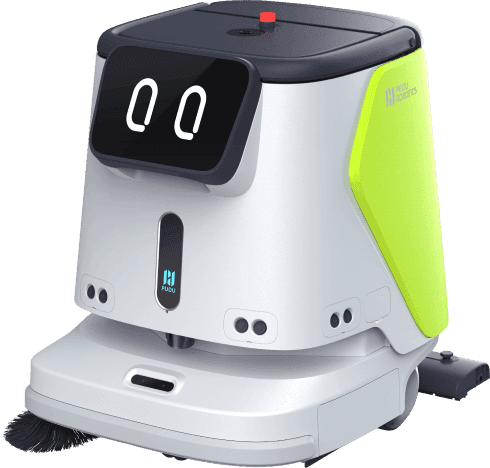
| PUDU CC1 | ~434 m²/h | 1 | ~A$30,100 | Sweep + vacuum + mop + scrub; auto water dock |
| CenoBots L3 | ~771 m²/h | 1 | ~A$32,800 | Scrub-only — would smear popcorn; manual refill |
| Gausium Phantas | ~268 m²/h | 2 | ~A$89,200 | 4-in-1 and quiet (≤60 dB), but pricier, needs 2 |
*Effective rate = manufacturer spec × uniform derate × 0.85 window duty — the same engine basis for every brand. The CenoBots L3's 2,016 m²/h is a theoretical maximum, so it takes the tighter 0.45 discount; the CC1 (700–1,000) and Phantas (350–700) are practical ranges and take 0.60.
Here the biggest headline number is a trap. The CenoBots L3 has the highest effective clean rate on the board — but it only mops and scrubs. It has no sweep or vacuum, so on a floor carpeted in popcorn it would push debris around inside a puddle. It also lacks an auto refill/drain dock, so a person has to babysit its tanks. Raw coverage is not fit.
The Gausium Phantas is a genuine 4-in-1 and the quietest on published specs (≤60 dB, handy for daytime lobby passes), but its lower effective rate needs two units, and at ~A$44,600 each that's a ~A$89,200 fleet.
That leaves the PUDU CC1: a true 4-in-1 that sweeps and vacuums the debris before it mops and scrubs, a single unit that finishes a ~4.6-hour clean inside its ~5-hour battery runtime with no mid-night recharge, and — the quiet difference-maker on a sugary floor — an auto dock that refills, drains and doses itself. It's also the cheapest option on the board.
The coverage plan
One CC1 maps the level as a single floor and works outward from an auto water dock, wet-scrubbing every flat hard-floor zone to a consistent standard. The odour-and-stickiness problem in a cinema is really a consistency problem — the far corridor and the back-row aisle are what get skipped when a tired crew runs out of time at midnight.
Percentages are representative cleaning quality, not audit data, on the flat hard floor the robot reaches. Stepped aisles and stairs are excluded — they stay a manual job — and amenities show ~88% because cubicle interiors are a manual detail. The robot handles the high-traffic floor the crew used to rush.
The nightly rhythm
The robot doesn't replace the fast between-session turnaround — staff still spot- reset each auditorium in the changeover gap. It replaces the slow, thankless overnight floor clean that used to eat the closing shift.
- Last session ends~11:40pm — house empties
- Staff spot-resetseats, bins, obvious spills
- Robot deep-scrub~1–6am, lobby → aisles, autonomous
- Auto dockrefill water, drain waste, recharge
- Doors open~10am — floors dry, clean, audited
The money
Before automation, the closing crew spent roughly 2.8 hours of each shift on the hard-floor sweep-and-mop — a rushed, partial pass (on busy weekends the aisles still got a lick and a promise), well short of the ~5 hours a thorough hand-clean of 2,000 m² would take. That 2.8-hour figure is this site's roster reality, not an engine output; the fleet sizing is what the planner computes. The CC1 now scrubs all 2,000 m² thoroughly overnight; attended time drops to about 1 hour for loading, emptying checks and clearing the occasional flagged spill. That's roughly 1.8 net hours a night displaced at a fully-loaded ~A$34/hour — about A$1,900 a month. Against a ~A$30,100 outlay:
A$30,100 upfront ÷ ~A$1,900 net monthly saving — break-even at about 16 months.
As always, the estimate was directionally right on labour and understated the value of consistency. The robot doesn't skip the back-row aisle of screen 7 at 2am, so the sticky-floor complaints that used to spike after a big-release weekend quietly went away — and the morning duty manager stopped starting the day with a mop.
What carried over
Three lessons repeat across every entertainment-venue rollout we've modelled:
- Match the machine to the mess. Popcorn and spills means you need sweep and scrub in the same machine. The highest-throughput scrubber on the market is the wrong tool if it can't pick up debris.
- Auto-dock earns its price on sugary floors. Where dirty water fills fast, a self-refilling, self-draining dock is the difference between "autonomous" and "needs a babysitter".
- Don't ask a robot to beat the changeover clock. Let staff own the 15-minute turnaround; give the robot the overnight deep clean it can actually finish.
Would it work for your cinema?
The honest answer is "it depends on your floor area, your window and your wage rates" — which is exactly what the planner is for.
- Run your own venue through the Fleet & ROI Planner to see the payback on your numbers.
- Or tell us about your site and we'll send a vendor-neutral shortlist with indicative pricing.
Frequently asked questions
- Can a cleaning robot clean a cinema between sessions?
- Not a whole auditorium in a 15-minute changeover — that stays a human spot-reset. Where a robot earns its keep is the overnight deep clean: one PUDU CC1 wet-scrubs roughly 2,000 m² of lobby, concourse, corridors and flat auditorium aisles (stepped aisles and stairs stay manual) in about a 4.6-hour autonomous run, so the hard floors are clean and dry before the doors open.
- What kind of cleaning robot suits sticky cinema floors?
- A 4-in-1 that both sweeps and scrubs, because cinema floors are popcorn and dropped debris on top of sticky soft-drink spills. The PUDU CC1 sweeps and vacuums the debris, then mops and scrubs the residue in one pass. A scrub-only machine would just smear popcorn around, which is why raw clean-rate isn't the same as fit.
- How many cleaning robots does a multiplex need?
- Often just one for the hard floors. In our composite 8-screen multiplex, a single PUDU CC1 covers about 2,000 m² of hard floor overnight at an effective ~434 m²/h; a compared 2-unit fleet was only needed because the alternative machine's effective rate was lower.
- What's the payback on a cleaning robot for a cinema?
- In this composite, about 16 months — a ~A$30,100 PUDU CC1 displacing roughly A$1,900 a month of the closing crew's hard-floor sweep-and-mop, net of supervision. Payback scales with how much hard-floor labour you currently pay for; run your own numbers in the Fleet & ROI Planner.
- Does the robot refill and empty its own water?
- The PUDU CC1's auto dock refills clean water, drains the dirty tank and doses detergent on its own. That matters on spill-heavy cinema floors, where a manual-fill machine would need staff to keep topping it up mid-clean.
Put these numbers to work
See which robot fits your facility and what it would save you.
Run the Fleet & ROI Planner